

Bitcoin is now a $2.2 trillion asset, and it powers a market twice that size. It acts as the backbone of digital assets, a settlement rail that never sleeps. Bitcoin was programmed to reward honesty through proof of work, blocks arrive on a fixed rhythm, and rules apply without exception.
Bitcoin leads the market, and its price direction moves the overall market direction. For Bitcoin, security comes from cost, not permission. Markets depend on this predictability, exchanges and wallets plan around it, and regulators measure it. Bitcoin miners run the network, and it is very important for Bitcoin security and integrity that this mining power remains distributed to avoid an attack on its network.
What Is a 51% Attack?
A 51% attack occurs when one entity or group secures more than half of a blockchain network’s total computing power. This power, called hash rate, enables them to alter the ledger. Bitcoin’s network hash rate reaches about 888 EH/s as of August 20, 2025.
It happens in three steps:
- Gain majority hash power, even for a short window.
- Build a private chain while the public chain keeps moving.
- Release the longer private chain, the network accepts it, and some recent transactions drop.
Developers have expressed concerns about this flaw since Bitcoin started in 2009. Yet, protections advance over time.
What Will Be the Outcome of a Successful Attack?
Attackers who succeed can reverse transactions and cause double-spending problems. For example, a person could spend the same Bitcoin twice, which damages trust. The network experiences disorder as modified blocks supplant valid ones. Markets frequently plunge in reaction, with Bitcoin’s price falling from its present value near $113,700. Exchanges will pause trading during the disruptions. Attackers may block specific transactions or claim all mining rewards. The main protocol will be ruined, and the trust in a blockchain network will be gone for good. Teams would organize forks for recovery. Still, Bitcoin will never be the same again.
Who Will Suffer?
Investors and users endure the most from a 51% attack. They forfeit money via double-spends or watch values drop. Exchanges encounter damage to their image and possible breaches. Miners beyond the attack group receive fewer rewards and incur greater expenses. In short, anyone doing a Bitcoin transaction will be at risk. Moreover, the massive price drop due to panic selling will impact every crypto holder.
For context, 11 years ago, in 2014, with GHash,io. had 51% mining share. They had to voluntarily reduce their hashrate to quell centralization concerns, but panic still ensued. Bitcoin price droppped 87% within a few months after this.
Bitcoin 51% Attack in August 2025: Odds
Bitcoin’s computing power now stands in the high hundreds of exahashes per second, and the top pools alone report well over 500 EH/s. That scale protects value, yet it also concentrates control.
- Foundry USA: 254 EH/s, 31.8% market share
- AntPool:9 EH/s, 19.3% market share
- ViaBTC:8 EH/s, 12.1% market share
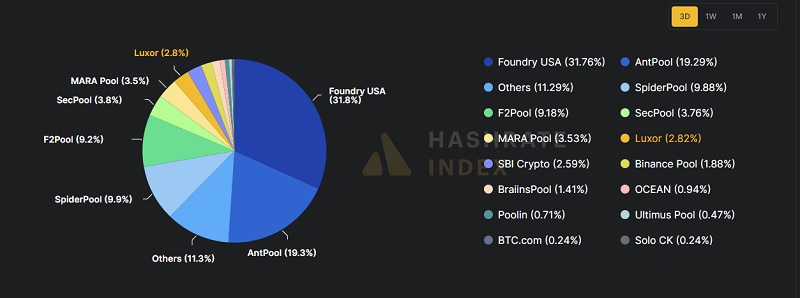

If two of these entities join hands, their combined share clears 51%. That threshold grants the ability to reorganize recent blocks and delay chosen transactions. The odds remain uncertain, yet the capability exists.
The pool’s miners would not notice in real time which chain they secure. Their rigs follow the job templates the pool assigns, and they work on whatever block the server provides.
A further concern surfaces across other proof-of-work networks. These three pools also command much of the hash rate on Bitcoin Cash, Litecoin, and Bitcoin SV. The firms have operated for years without incident. The fact remains, they already command most of the hashing power across the most mined and most profitable cryptocurrencies.
Has a 51% Attack Ever Happened?
Yes, the most recent 51% attack was executed 3 days ago on August 17, 2025, on Monero XMR. Qubic, a decentralized platform, strategically withheld some blocks to claim they had more than half of the mining power, which resulted in an illusion of a 51% attack on the network.
Though Bitcoin has avoided a successful 51% attack so far, other blockchains have suffered. Attackers attacked Ethereum Classic in 2019 and double-spent over $1 million through chain reorganization. They targeted exchanges in that case.
Bitcoin Gold suffered a similar attack in 2018, where hackers seized control and double-spent millions. Two mining pools launched a 51% attack on Bitcoin Cash in May 2019 to stop an unknown miner from taking certain coins. These examples show dangers for smaller networks with modest hash rates.
When two entities control over 51% of the mining power, the balance of the network is lost. Such dominance threatens fairness and places the entire system at risk of manipulation. Bitcoin and the crypto markets are now working on their goodwill instead of trustless protocols.