

Bitcoin is in a real bull run as it updates its all-time highs almost every day. The impact of crypto bull runs pours into altcoins, but not as much as expected. Ethereum barely moves. Despite all the bullish headlines during the last two weeks, the price of Ethereum shows minimal bullish signs compared to Bitcoin’s price action.
During the second week of, Spot ETH ETFs pulled in over $900 million in a single week, their best inflow since launch. Major institutions stepped up, too, and started piling up Ethereum. BlackRock added 33,237.72 ETH (about $85.4 million) on July 4, while publicly traded SharpLink Gaming bought 10,000 ETH ($29 million) directly from the Ethereum Foundation on July 11.
Not just that, Exchange reserves dropped to 18.59 million ETH, the lowest level ever recorded, while staked ETH soared to 29.91 million ETH, its highest level on record. Each data point points in one direction: a classic supply squeeze. Less ETH on exchanges should mean less sell-side pressure. More ETH locked in staking shrinks the liquid supply and increases price stability.

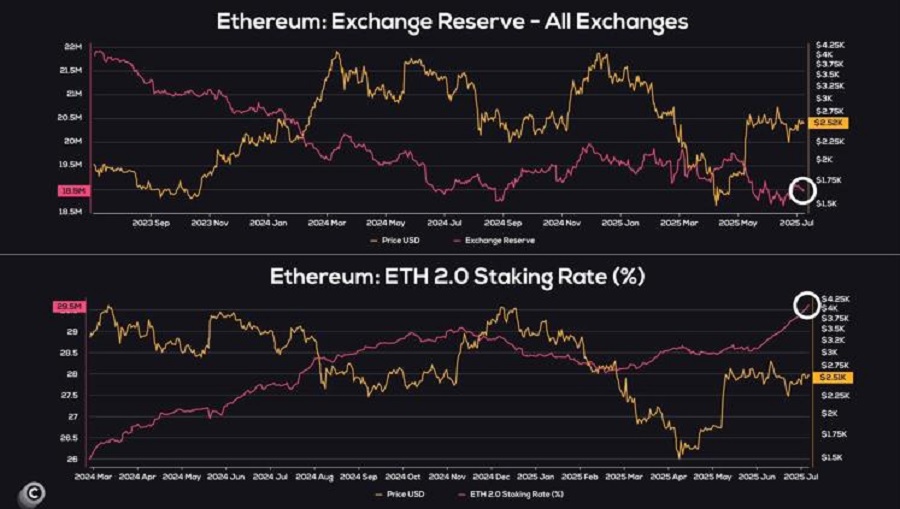
Institutional buys inject fresh demand. Yet price action refuses to follow. CME’s CFTC data shows net short positions reached a historic peak of –13,291 contracts on July 13, which showcased a lack of bullish sentiments in the traders despite all the bullish data points. Ethereum barely moves, trading in a narrow range even as Bitcoin makes new all-time highs.
That raises a serious question: why ETH is not going up despite bullish positive headlines, massive accumulation, and encouraging on-chain data? If not this, what actually drives the price of Ethereum?
Why ETH is not going up?
Ethereum doesn’t lack demand, we know that. Then why Ethereum is not going up? Here is the plausible explanation.
Even as BlackRock’s spot ETF funneled $900 million in weekly inflows and its affiliates bought $85 million worth of ETH, those purchases represent only about 2.4 percent of Ethereum’s daily trading volume. In a deep‑liquidity environment, large orders simply absorb into order books without exerting visible upward pressure. At the same time, futures markets carry record-high bearish bets. Data showing –13,291 net short contracts on the CME indicates that speculators continue to hedge against or bet on downward moves. That continuous short pressure can neutralize buying momentum, since liquidations and forced covers occur only after a major bearish move.

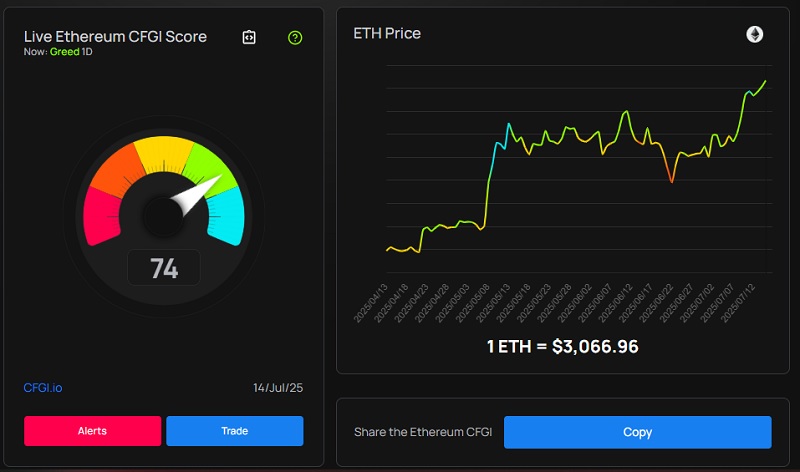
Retail sentiment adds another layer of resistance: the Ethereum Fear & Greed Index sits at 74, signaling that individual investors remain too cautious to chase a rally. Without retail follow-through, even major institutional buying orders lose their impact.
Portfolio managers compound the effect through routine profit rebalancing as they sell portions of newly acquired ETH to maintain target allocations. On top of this, major whales buy coins directly from long-term holders via over-the-counter transfers. Those off-exchange transactions bypass public order books entirely and leave no visible supply and demand change.
All of these factors combined to dilute the impact of bullish sentiment on Ethereum price, and the price remained range-bound.
Ethereum Price Action July 15-16

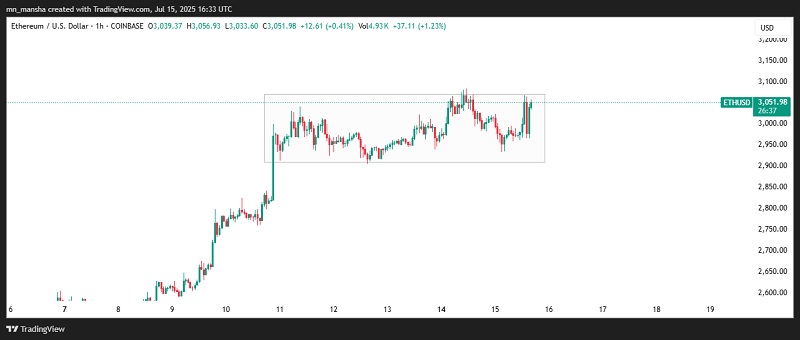
On July 15, Ethereum is trading inside a clear consolidation box between $2,950 and $3,100. After a sharp rise from $2,600 on July 7, the price seems to have stopped under the upper boundary of that range. Ethereum price repeatedly tested the resistance of $3,100, however, it could not break above that zone. The ETH price is also holding strong support. That pattern reflects a tug‑of‑war between bulls and bears.
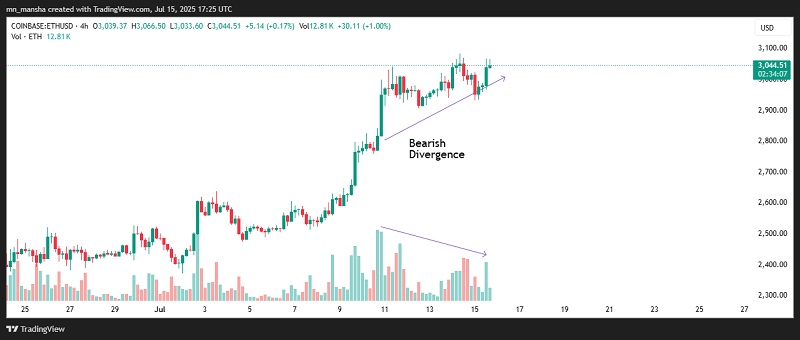
A closer look at the four-hour chart reveals a classic bearish divergence. Volume peaked at the beginning of the rally and then fell even as Ether made higher highs. This mismatch signals a weakening bullish trend among buyers. In effect, each higher swing carried less fuel. Consequently, the market now faces a decision point: a surge in demand will require a clear breakout above $3,100. However, if the price falls below the support at $2,950 could trigger a drop back toward $2,900 or lower.
Now that Bitcoin is also showing signs of reversal as the price dropped from an ATH of $23,300 to a low of $115,700, it will become challenging for Ethereum to continue its bullish ascent. Ethereum price is not going up, but it’s also not going down. The tug of war continues until one side gains clear control.