
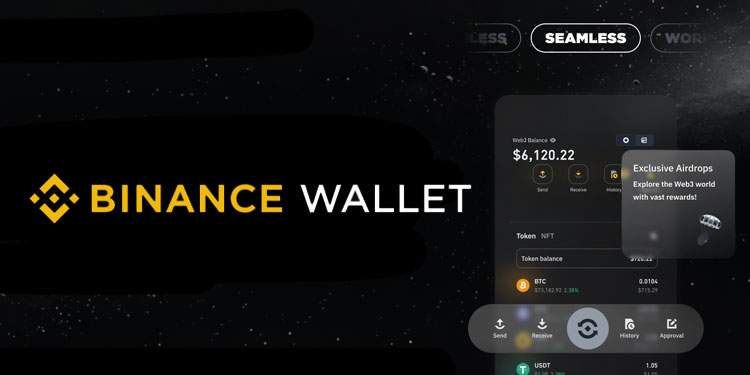
Binance Wallet has introduced a feature allowing users to pay network gas fees with USDT across several major blockchains, removing the need to maintain balances of native tokens solely to complete transactions.
The feature covers BNB Smart Chain, Ethereum, Solana, and TRON, according to the information provided by Binance. By handling the underlying gas payment and deducting the equivalent amount in USDT, the wallet is designed to simplify transactions for users who may otherwise need to acquire a separate token before moving digital assets.
Binance Wallet’s USDT gas payment feature allows users to cover transaction fees with USDT across BNB Smart Chain, Ethereum, Solana, and TRON, reducing the need to hold native tokens solely for network fees.
USDT Removes a Common Transaction Barrier
Blockchain transactions generally require users to hold the network’s native asset to pay gas fees. This can create an additional hurdle for users who primarily hold stablecoins or other tokens.
Under Binance Wallet’s new system, users can use USDT to cover those costs instead. For example, someone transferring TRC-20 assets on the TRON network would no longer need to maintain a separate TRX balance specifically to pay for the transaction.
The change could make wallet-based transactions easier for users who are less familiar with the mechanics of different blockchain networks. It also reduces the need to make small token purchases simply to cover transaction fees.
Binance’s FAQ, updated on Sept. 25, 2026, identifies the supported networks and indicates that the feature can be used for USDT transfers as well as transactions involving other supported tokens on those networks.
The approach represents a form of fee abstraction, in which the wallet handles the underlying network requirement while presenting users with a more familiar payment asset.
TRON Promotion Offers Zero-Fee Transfers
The TRON implementation includes a limited-time promotion that further reduces the cost of eligible transfers. According to the provided information, the promotion runs from Sept. 23 through Dec. 22, 2026, with qualifying TRON transactions carrying no gas fee during that period.
TRON DAO is supporting the promotion, providing an additional incentive for users to test the USDT-based fee mechanism.
After the promotional period ends, the standard fee for TRON transfers is expected to be 1 USDT per transaction. The fixed fee structure could make transaction costs easier for users to understand because the amount is denominated in the stablecoin they are already using.
The TRON promotion provides zero-fee eligible transfers through Dec. 22, while the post-promotion structure sets a predictable 1 USDT fee per transaction.
Simplifying Access to On-Chain Transactions
Binance Wallet’s position within the broader Binance ecosystem could give the feature a large potential user base. Users who already hold USDT through Binance may be able to access the wallet functionality without acquiring another asset solely for gas payments.
The setup also avoids some of the additional steps that can discourage newer users, including transferring funds between wallets, purchasing small amounts of native tokens, or navigating unfamiliar interfaces.
No gas? No problem. ⛽
Don’t have enough of the network’s native token to cover gas? Binance Wallet now lets you pay gas fees with USDT directly from your wallet.
No need to stop and get BNB, ETH or TRX first. Just select USDT as your gas payment method and continue your… pic.twitter.com/bZMNrXbxba
— Binance Wallet (@BinanceWallet) September 25, 2026
For experienced users, the change could offer a more predictable way to manage transaction expenses. For newer participants, it may reduce one of the technical concepts that must be understood before using decentralized networks.
The feature also puts greater emphasis on stablecoins as a payment mechanism within blockchain infrastructure. Rather than requiring users to distinguish between the asset being transferred and the token needed to pay network fees, the wallet can use USDT as the visible fee currency while managing the underlying requirement.
Competition With Centralized Transaction Costs
The predictable fee structure after the TRON promotion could also provide a straightforward benchmark against centralized exchange withdrawal charges. A fixed 1 USDT transaction cost gives users a clear figure when comparing on-chain transfers with alternatives offered by centralized platforms.
By allowing users to pay gas fees in a widely used stablecoin, Binance Wallet is lowering a technical barrier that can complicate blockchain transactions and potentially make on-chain transfers more accessible to a broader user base.
The longer-term impact will depend on network support, transaction costs, and how widely users adopt fee abstraction. However, the move reflects a broader effort to make blockchain wallets operate more like conventional financial applications, where users generally do not need to manage the underlying infrastructure required to process a payment.