
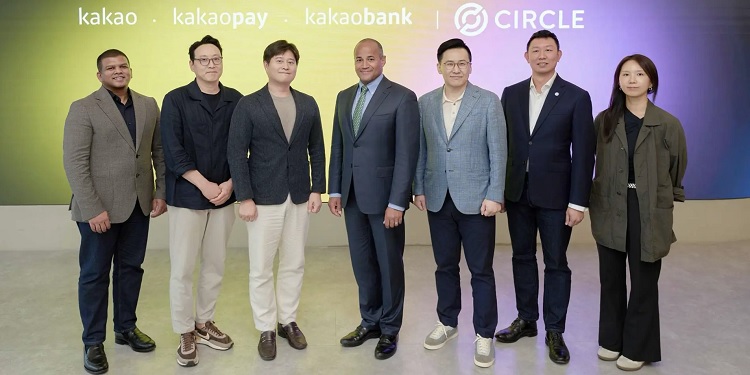
Circle, the issuer of the USDC stablecoin, has signed a memorandum of understanding (MoU) with South Korea’s Kakao Group to explore blockchain-powered payment systems, digital asset technologies, and the potential development of a Korean won-backed stablecoin. The agreement brings together Circle’s global blockchain infrastructure with Kakao Group’s extensive digital ecosystem, which includes Kakao Corp., Kakao Pay Corp., and KakaoBank Corp.
The collaboration is intended to examine how blockchain technology can support digital payments, tokenized financial services, and cross-border transactions in one of Asia’s largest retail cryptocurrency markets. While the companies have outlined areas of potential cooperation, they have not announced specific commercial products, implementation schedules, or issuance plans for a won-denominated stablecoin.
Circle and Kakao Group have signed a memorandum of understanding to explore blockchain-based payment infrastructure, tokenized financial services, and the potential development of a Korean won stablecoin.
Under the agreement, the two organizations will evaluate business models that combine Kakao Group’s consumer platforms and financial services with Circle’s blockchain technology and international payment infrastructure. Their discussions will focus on improving payment efficiency, merchant settlements, cross-border remittances, and interoperability between blockchain networks and traditional financial systems.
Kakao Group intends to leverage the broad reach of KakaoTalk, one of South Korea’s most widely used messaging platforms, together with Kakao Pay’s payment ecosystem and KakaoBank’s digital banking services. The companies are also considering the development of shared infrastructure that could allow domestic businesses to build blockchain-based financial services using common technology standards.
Regulatory Framework Remains a Key Consideration
Although the memorandum establishes a framework for cooperation, it is not a binding commercial agreement. Both companies indicated that they are reviewing potential opportunities rather than committing to immediate product launches. The structure of any future Korean won stablecoin, including issuance mechanisms and operational timelines, has not yet been determined.
The project’s progress will largely depend on South Korea’s evolving regulatory framework for digital assets. Policymakers are currently reviewing legislation, including the proposed Digital Asset Basic Act, alongside rules that will define which entities may issue and manage won-denominated stablecoins.
Circle’s Chief Commercial Officer, Kash Razzaghi, indicated that South Korea has developed into one of the world’s leading digital markets with a strong foundation for financial innovation. He stated that Circle intends to pursue opportunities that align with the country’s regulatory requirements while combining its global blockchain infrastructure with Kakao Group’s extensive platform and financial ecosystem.
Kakao Pay Chief Executive Officer Shin Won-keun, who also leads Kakao Group’s joint stablecoin task force, stated that building competitiveness in digital assets requires more than technological capabilities alone. He explained that Kakao Group intends to work closely with Circle to prepare for the development of a Korean-style digital asset ecosystem by leveraging its experience in digital platforms, payment services, and financial technology.
The companies will evaluate blockchain solutions for cross-border payments, merchant settlements, and interoperability between digital asset networks and traditional financial systems.
Growing Focus on Stablecoin Adoption
The agreement reflects increasing interest among financial technology companies in integrating stablecoins into mainstream payment infrastructure. Stablecoins have gained prominence as a means of facilitating faster and more efficient transactions while reducing the volatility typically associated with cryptocurrencies.
Circle 🤝 Kakao Group
Circle and Kakao Group have signed an MOU to explore blockchain-based payment infrastructure and digital asset technologies in Korea.
Together, we’ll assess opportunities for USDC and Circle’s global payment rails across payments, settlement, and digital… pic.twitter.com/MmZRd19iIH
— Circle (@circle) July 23, 2026
For Circle, the partnership expands its presence in South Korea following previous collaborations within the country’s digital asset sector. The company continues to promote USDC and related blockchain infrastructure as part of broader efforts to increase the adoption of regulated stablecoin payment solutions across international markets.
South Korea remains one of the world’s most active cryptocurrency markets, with strong retail participation and growing institutional interest in blockchain-based financial services. However, regulatory uncertainty has slowed the commercialization of certain digital asset initiatives, particularly those involving fiat-backed stablecoins.
The collaboration highlights growing industry efforts to integrate stablecoins into mainstream financial services while positioning both companies to capitalize on South Korea’s evolving digital asset regulatory framework.
As lawmakers continue developing comprehensive digital asset regulations, partnerships such as the one between Circle and Kakao Group are expected to shape the future of blockchain-based payments in the country. Market participants will be closely watching regulatory developments to determine when stablecoin-based financial products can move from exploratory discussions to commercial deployment within South Korea’s financial system.