
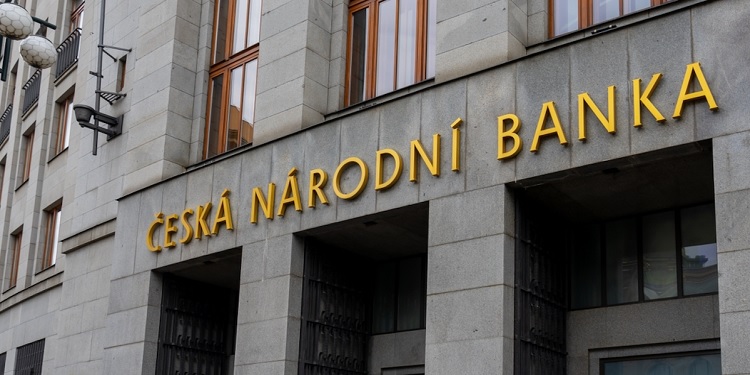
The Czech National Bank (CNB) has issued its first bond using blockchain technology, marking a step toward exploring distributed ledger technology (DLT) in the country’s financial infrastructure. The central bank conducted the initiative through CNB Lab, its financial innovation program, successfully testing bond issuance, trading, and settlement using a blockchain-based system.
The experimental bond was denominated in Czech koruna, with each unit carrying a face value of 10,000 koruna, equivalent to approximately $290. The trial examined several financial market activities, including bond trading, interest payments, and repurchase agreement (repo) transactions.
The project demonstrated that blockchain technology could support the issuance, trading and settlement of government-related financial instruments, with transactions completed almost in real time.
The initiative forms part of the central bank’s broader efforts to understand how emerging technologies could improve the efficiency of financial markets and prepare traditional banking infrastructure for potential changes in securities trading and settlement.
CNB Lab Explores Blockchain-Based Financial Infrastructure
The bond issuance was conducted as a controlled experiment under CNB Lab, which provides a framework for evaluating financial innovations and their potential applications.
Distributed ledger technology allows transaction records to be maintained across a shared digital infrastructure rather than relying exclusively on centralized databases. In securities markets, this approach could potentially reduce the number of intermediaries involved in maintaining ownership records, processing transactions, and coordinating settlement.
Traditional bond transactions frequently involve several stages, including trade execution, ownership verification, and the transfer of funds. These processes can require coordination among financial institutions and settlement infrastructure providers, sometimes resulting in delays between the execution of a trade and the final transfer of assets.
By testing blockchain-based issuance and settlement, the Czech central bank sought to examine whether these activities could be performed more efficiently through a shared digital ledger.
The experiment also covered interest payments, an important component of bond administration. Blockchain-based systems could potentially automate payment calculations and distributions through predefined digital instructions, subject to the relevant contractual and legal requirements.
Another important component was the testing of repo transactions. Repurchase agreements are widely used in financial markets for short-term borrowing and liquidity management, typically involving the sale of securities with an agreement to repurchase them at a later date.
Including repo transactions allowed the central bank to examine how blockchain infrastructure might support more complex financial market operations beyond the initial issuance and trading of securities.
Near-Real-Time Settlement Highlights Potential Benefits
One of the notable outcomes of the experiment was the ability to complete settlement almost in real time. Faster settlement could reduce the time financial institutions spend waiting for transactions to be finalized and potentially lower certain operational and counterparty risks.
The trial demonstrated the potential for distributed ledger technology to bring bond issuance, secondary trading and settlement activities closer together within a more integrated financial infrastructure.
However, the experiment represents a technological assessment rather than an announcement of a permanent blockchain-based bond issuance program. Further evaluation would be necessary before determining whether the technology could be adopted for broader financial market operations.
The central bank will also need to consider operational resilience, cybersecurity, legal certainty, interoperability and the ability of blockchain systems to integrate with existing financial infrastructure.
Czech Central Bank Signals Interest in Financial Innovation
CNB Governor Aleš Michl indicated that the institution intended to maintain a conservative approach to monetary policy while remaining open to innovation in other areas of its operations.
He viewed the blockchain bond experiment as another step toward preparing the financial system for future infrastructure developments.
The distinction highlights the central bank’s approach to technological innovation. While monetary policy decisions remain guided by its established responsibilities, the institution is exploring how new technologies could improve financial services and market operations.
Central banks worldwide have increasingly examined tokenization and distributed ledger technology for securities issuance, payments and settlement. These experiments reflect growing interest in modernizing financial infrastructure while maintaining regulatory oversight and financial stability.
The Czech National Bank‘s first blockchain-based bond issuance adds to these efforts, providing an opportunity to assess whether distributed ledger technology can deliver faster settlement and more efficient securities market operations without compromising institutional safeguards.