
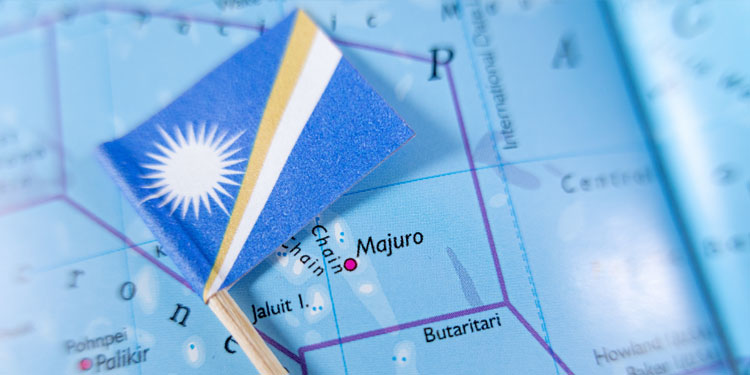
The Republic of the Marshall Islands has begun rolling out a blockchain-based option for distributing universal basic income payments, offering eligible citizens the ability to receive dollar-denominated digital tokens directly on their mobile phones. The initiative uses the Lomalo mobile application in combination with wallets powered by Crossmint and settlement on the Stellar blockchain. Officials have framed the rollout as a practical response to the geographic and logistical challenges of delivering cash across a country made up of roughly 1,200 islands spread over a vast area of the Pacific Ocean.
Government representatives have explained that access to physical US dollars remains inconsistent across the islands. Cash often arrives by boat, automated teller machines can run out of funds for extended periods, and residents may be required to travel long distances simply to withdraw money. The digital option is intended to reduce this daily friction by allowing funds to move electronically and reach recipients without reliance on physical cash distribution.
How the Lomalo and Stellar System Works
Under the program, universal basic income payments are distributed through the Lomalo app, where recipients can store funds in a Crossmint-powered wallet. The system enables peer-to-peer transfers that settle almost instantly, allowing users to send money to one another without intermediaries. By operating on the Stellar blockchain, transactions are processed at low cost and with near-immediate finality, even when funds are sent between distant atolls.
Officials have noted that the use of blockchain technology allows payments to circulate efficiently within local communities. Residents can hold digital dollars on their phones, make transfers when needed, and reduce dependence on limited cash infrastructure. The design is intended to work alongside existing financial habits rather than forcing a complete shift away from familiar forms of money.
USDM1 and Sovereign Digital Dollars
At the center of the rollout is USDM1, a fully collateralized digital sovereign bond issued by the Marshall Islands. The instrument is backed on a one-to-one basis by short-term US Treasury securities. Unlike privately issued stablecoins, USDM1 represents a sovereign obligation and is governed under New York law, with collateral held by regulated trust entities in the United States.
The government has indicated that this structure allows digital dollars to circulate domestically without introducing a new national currency or changing the country’s fully dollarized monetary system. By relying on a sovereign-backed digital asset, the program seeks to preserve legal and monetary continuity while improving how funds are distributed and accessed.
Addressing Banking and Liquidity Constraints
The initiative also responds to structural challenges facing Pacific Island nations. Over the past decade, many countries in the region have lost hundreds of correspondent banking relationships, increasing reliance on a small number of foreign banks. For the Marshall Islands, this has meant higher transaction costs, fragile remittance channels, and limited flexibility in managing liquidity.
HISTORIC NEWS 🇲🇭
We’re helping tokenize a nation.
The Marshall Islands is launching blockchain-based UBI, giving citizens dollar-denominated tokens they can receive, store, and send peer-to-peer from their phones.
Powered by Crossmint Wallets pic.twitter.com/lvAWjTI6SW
— Crossmint (@crossmint) December 16, 2025
Officials have argued that blockchain-based distribution can help ease these pressures by reducing dependence on correspondent banking links for domestic transfers. Digital delivery of funds is expected to lower the economic burden created by cash shortages, reduce incentives for cash hoarding, and improve day-to-day liquidity across communities.
The universal basic income program, known as ENRA, is funded through the Compact Trust Fund, which surpassed $1.3 billion in assets in 2025. By pairing this funding source with digital distribution, the government aims to ensure that benefits reach citizens more reliably and efficiently.
Part of a Global Shift in Public Finance
The Marshall Islands’ approach reflects a broader international movement toward tokenized public finance. Other governments have explored similar ideas through central bank digital currency pilots, tokenized bonds, and blockchain-based payment rails. These efforts generally seek to modernize settlement systems while maintaining existing legal and monetary frameworks.
For the Marshall Islands, however, officials have emphasized that the initiative is not a technology experiment or a symbolic embrace of crypto. Instead, it is positioned as a pragmatic response to persistent infrastructure failures in a geographically dispersed nation. Blockchain is being used as a delivery mechanism rather than a replacement for the US dollar.
If the system proves effective at scale, USDM1 and the Lomalo platform could offer a real-world example of how sovereign-backed digital assets can support welfare programs and domestic liquidity without disrupting established dollar-based systems or existing law.