
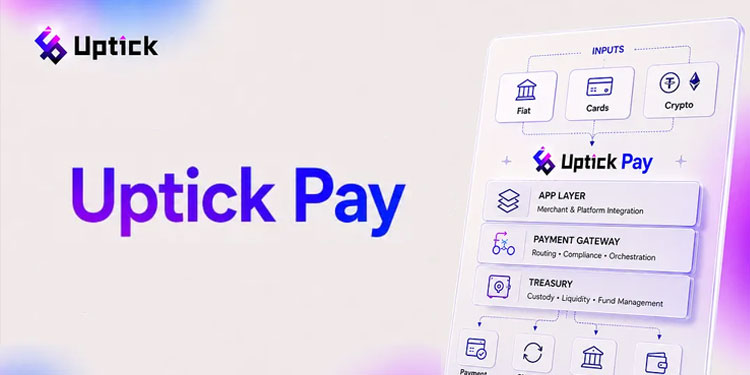
Uptick Network has introduced Uptick Pay, a new payment infrastructure designed to connect traditional finance and blockchain-based transactions within the broader Web3 ecosystem. The launch represents a significant step in the company’s strategy to simplify digital payments by enabling seamless transfers involving fiat currencies, cryptocurrencies, and bank cards. According to an official announcement from Uptick Network, the initiative is intended to strengthen the commercial foundation of Web3 by making digital payments more accessible for consumers, businesses, and platform operators.
The newly launched Uptick Pay combines fiat currencies, stablecoins, and card payments into a unified payment framework, lowering barriers for mainstream users while improving transaction efficiency across Web3 applications.
As part of the rollout, Uptick Network also introduced the beta version of the Uptick Pay sandbox environment. The testing platform is expected to allow developers to integrate payment capabilities into their applications and evaluate transaction workflows with reduced technical complexity. By offering a developer-friendly environment, the company aims to accelerate the creation and deployment of payment-enabled Web3 services.
Three-Tier Architecture Supports Cross-Chain Transactions
The launch aligns with Uptick Network’s broader strategy of building a scalable and dependable Web3 economy capable of serving evolving commercial requirements. Over time, the company has expanded its infrastructure to address enterprise and consumer use cases. Its ecosystem includes Uptick Chain, an Ethereum Virtual Machine-compatible blockchain, a business-focused application layer, and asset management solutions supporting real-world assets (RWAs) and non-fungible tokens (NFTs). These components are intended to encourage broader user participation while supporting business adoption.
Unlike traditional payment systems, Uptick Pay has been structured around a three-layer financial architecture. The foundation consists of custody and treasury management services, while higher layers incorporate a payment gateway and an application framework. The company indicated that an integrated routing engine links fiat currencies, digital assets, and card payment methods, enabling efficient settlement and clearing across multiple payment channels.
Introducing: Uptick Pay ✅
Unified infrastructure for fiat, card, and crypto payments, built for users, merchants, and platforms across the Uptick ecosystem.
Learn more about the release ⤵️https://t.co/RedloNzBhs
— Uptick Network (@uptickproject) July 25, 2026
The platform also introduces a unified routing engine capable of connecting fiat payments, cryptocurrencies, and card transactions while supporting cross-chain settlements through chain abstraction technology.
According to Uptick Network, the platform supports multiple payment channels, including Google Pay, leading stablecoins such as USDT and USDC, and cross-chain settlement capabilities. These features are designed to provide users with greater flexibility when transferring funds between conventional financial systems and blockchain networks.
Focus on AI Payments and Mainstream Adoption
The company further stated that Uptick Pay has been designed to accommodate micropayments alongside high-value transactions. This capability is expected to support emerging artificial intelligence finance applications by enabling automated agent-to-agent payments while continuing to facilitate larger commercial transfers.
By integrating payment services into both online and offline commercial activities, Uptick Network aims to accelerate mainstream Web3 adoption and move blockchain technology beyond technical experimentation into practical everyday commerce.
The company believes that embedding blockchain-enabled payments into routine consumer experiences could help reduce friction between traditional financial services and decentralized technologies. Through this approach, Uptick Network seeks to create a payment ecosystem that supports businesses, developers, and consumers while advancing the commercial maturity of Web3. The latest rollout reflects the company’s continuing efforts to build infrastructure that accommodates both established financial systems and decentralized digital assets, potentially broadening the reach of blockchain-based commerce across a wider range of real-world applications.