
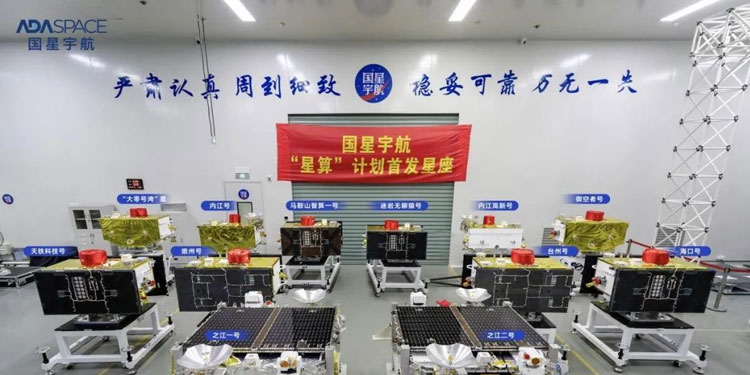
In a landmark development for the global space and technology sectors, Guoxing Aerospace achieved a significant breakthrough on May 14, 2025, with the successful deployment of 12 satellites under the Space Computing Constellation 021 mission. The satellites were launched using a Long March 2D rocket from the Jiuquan Satellite Launch Center at 12:12 PM Beijing time and reached their intended orbits without incident. This mission marked the first successful implementation of a dedicated space computing constellation globally, signaling a transformative shift toward the concept of “space-based computing.”
This launch served as the debut mission for Guoxing Aerospace’s ambitious “StarCompute” program and simultaneously marked the initiation of the “Trisolaris Computing Constellation” project, a broader initiative spearheaded by Zhijiang Laboratory. The 12 satellites forming this constellation were developed by Guoxing Aerospace with financial backing from multiple organizations. A notable highlight of this launch was the naming of one of the satellites after the NFT Bored Ape Yacht Club (BAYC) #7573, marking a symbolic intersection of Web3 culture and space-based computing technology.
Historically, satellite applications have been restricted to communication, Earth observation, or navigation. This new class of “computing satellites” is being positioned as a fourth category—one that could underpin the foundational capabilities of the other three. Unlike traditional satellite configurations, this constellation introduces a unique architecture that facilitates distributed computing and inter-satellite collaboration through advanced networking.
As per information provided by Guoxing Aerospace, the satellite lineup in the constellation includes:
- Neijiang (Star Era-27)
- Neijiang Gaoxin (Star Era-28)
- Taizhou (Star Era-29)
- Haikou (Star Era-30)
- Ma’anshan Intelligent Computing-1 (Star Era-31)
- Chongzhou (Star Era-32)
- Tiantie Technology (Star Era-33)
- Bored Ape #7573 (Star Era-34)
- Yukunzhe (Star Era-35)
- Great Zero Bay (Star Era-36)
- Zhijiang-1 (Star Era-37)
- Zhijiang-2 (Star Era-38)
These satellites are designed to function as a tightly integrated system through laser-based inter-satellite communication, high-speed data transfers, and decentralized computing protocols. This setup will allow the constellation to perform on-orbit demonstrations of emerging capabilities such as distributed artificial intelligence, decentralized cloud infrastructure, and blockchain operations in space.
Representatives from Guoxing Aerospace explained that the project’s core objective was to transition certain computing workloads from ground-based systems to orbital infrastructure. The aim is to enable a future where data collected in space can be processed in space itself, thus reducing latency and enabling real-time applications. They emphasized that such capabilities would place China in a leading position within the emerging global market for space-based computational infrastructure.
Wang Jian, Director of Zhijiang Laboratory and Academician at the Chinese Academy of Engineering, elaborated on the broader implications of the project. He noted that while a single satellite might achieve computing power at the teraflop level, the coordinated function of multiple satellites could scale this to petaflop-level performance. He likened the development to how the internet aggregates individual computers into a powerful collective, asserting that the constellation’s design would significantly increase the efficiency and utility of space assets. According to him, this paradigm shift is likely to bring disruptive changes to the aerospace industry.
The inclusion of BAYC #7573 as a satellite’s namesake was presented as a cultural milestone, reflecting the NFT’s prior association with various artificial intelligence initiatives. Its role in this project symbolizes the growing relevance of Web3 technologies in the realm of advanced scientific research. Observers view this as a concrete example of how digital communities and cutting-edge technological innovation are beginning to converge, particularly in areas like the space economy and decentralized computing.