
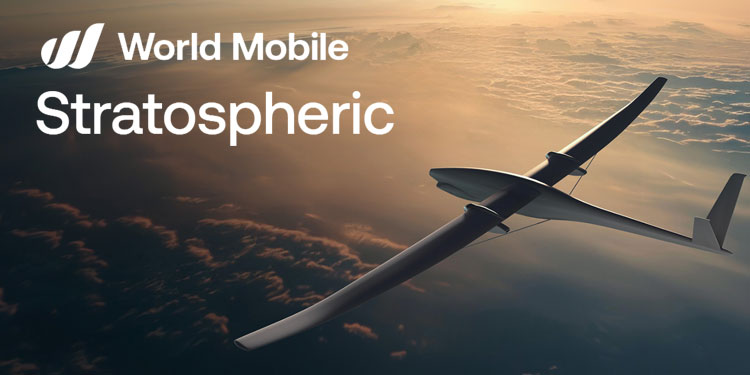
Telecommunications blockchain firm World Mobile has entered into a strategic partnership with Protelindo, Indonesia’s largest digital infrastructure provider, to deploy a stratospheric platform designed to expand global connectivity. Protelindo, whose network of telecom towers and fiber infrastructure spans the Indonesian archipelago, will integrate World Mobile’s technology to deliver communication services to remote and underserved areas, significantly improving access to mobile networks.
The initiative, known as World Mobile Stratospheric, is centered on the use of high-altitude, hydrogen-powered airships. These stratospheric balloons, capable of operating at altitudes between 15 and 20 kilometers, are engineered to provide direct mobile phone connectivity through a blockchain-based infrastructure. This approach aims to address the persistent connectivity gaps in regions where traditional telecom solutions are costly or logistically challenging to deploy.
Tested for Large-Scale Mobile Access
Field trials conducted in the UK, Europe, and the Middle East have demonstrated the platform’s ability to support up to 500,000 simultaneous mobile connections. The technology promises to deliver higher bandwidth and lower latency than conventional infrastructure, while also significantly reducing both operational and environmental costs. World Mobile has claimed that its system could cut environmental impact by up to 99% compared to traditional telecom methods, aligning with growing sustainability goals in the global tech and telecommunications industries.
At the center of the project is World Mobile’s native token, WMTX, which is used to facilitate network operations and transactions. According to data from CoinMarketCap, WMTX currently ranks in the 400s by market capitalization and trades at approximately $0.15.
Addressing Industry Skepticism
Despite the growing adoption of blockchain across industries, skepticism remains within traditional telecom sectors about its scalability and necessity. World Mobile has positioned its model not as a direct replacement for existing systems but as a complementary solution, particularly in markets such as the United States, where connectivity gaps still exist.
The company’s leadership has emphasized that by integrating aerospace engineering with token-based economics, the project is intended to deliver faster, more cost-effective, and environmentally sustainable connectivity. This combination of advanced aeronautical platforms with blockchain technology is seen as a way to democratize network access while reducing reliance on energy-intensive terrestrial infrastructure.
Potential Beyond Telecommunications
In addition to mobile communication services, the airship’s extended range and payload capacity open the door for applications beyond telecom. The same stratospheric infrastructure could potentially be adapted for other blockchain-powered operations, including data relay, disaster response coordination, environmental monitoring, and advanced sensor networks.
Industry analysts view the World Mobile–Protelindo partnership as an ambitious example of how blockchain can be paired with aerospace technology to tackle connectivity challenges on a global scale. If successful, the deployment in Indonesia could serve as a blueprint for similar projects in other regions where geographical and economic barriers hinder the expansion of conventional telecom networks.