
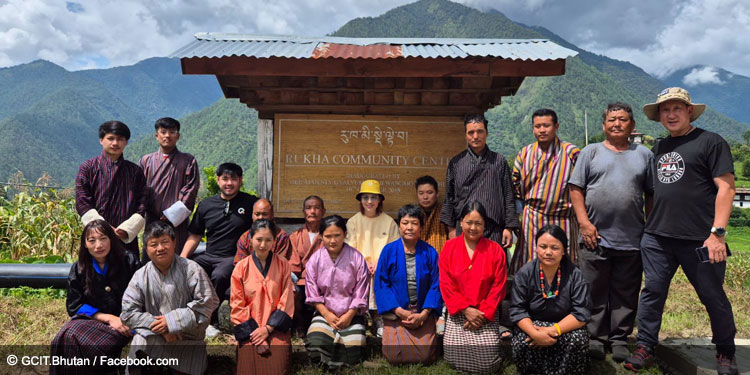
Singapore-based digital asset infrastructure company Qore3 and Bhutan’s Gyalpozhing College of Information Technology (GCIT) have partnered to introduce blockchain technology and digital financial tools to a Himalayan farming community. The initiative, known as Project Digital Village, will initially involve 21 households in Rukha Village, in Bhutan’s Wangdue Phodrang district, with a focus on agricultural transactions, community finance and digital inclusion.
The project will deploy multi-party computation (MPC) wallet solutions, explore a utility token-based model for community finance, and pilot artificial intelligence-assisted digital wallets to assess how decentralized technologies can support rural livelihoods. The initiative aims to demonstrate how blockchain infrastructure can serve communities beyond major financial centers while allowing residents to determine how the technology is used within their local economy.
Blockchain Research Focuses on Community Needs
Project Digital Village will examine how distributed ledger technology can support agricultural transactions and strengthen financial access for rural households. The participating organizations intend to develop practical applications that reflect the community’s existing economic activities and requirements rather than imposing a technology-driven model without local input.
The selection of Rukha carries historical significance for Bhutan’s community development efforts. The village was the starting point of an integrated rural development program established by the Tarayana Foundation, which was founded in 2003 by Queen Mother Ashi Dorji Wangmo Wangchuck. The foundation subsequently expanded its development work to more than 150 villages across Bhutan and is participating in the blockchain initiative.
Switzerland’s Lucerne University of Applied Sciences and Arts is also involved in the project. Its participation brings together researchers, educators, and blockchain industry participants to explore practical applications of distributed ledger technology.
Field Research and AI Development Support Implementation
Fieldwork began in August 2026, when researchers from GCIT and Tarayana visited Rukha to examine household requirements and existing community practices. GCIT President Audrey Low and Qore3 Head of Partnerships Jeffrey Cheong also participated in the visit, which was intended to establish a foundation for developing technology suited to the village’s needs.
During the same period, Cheong conducted a workshop at GCIT on multi-agent AI development for faculty members and students. The workshop introduced concepts relevant to the development of digital tools using white-label technology stacks, which can be adapted and deployed under different organizations’ brands.
The combination of blockchain-based wallets and AI-assisted tools is intended to connect applied research with practical community use, while emphasizing accessible technology, clear controls, and locally defined requirements.
Qore3 provides digital asset infrastructure for institutions, investment funds, fintech companies, payment platforms and developers. Its platform combines non-custodial MPC wallets, role-based permissions, approval thresholds and multi-chain treasury management. It also supports controlled and auditable workflows for automated operations.
GCIT, part of the Royal University of Bhutan, specializes in computer science, cybersecurity and digital innovation. Through its School of Future Computing and School of Interactive Design and Development, the college incorporates industry projects, entrepreneurship and applied research into its educational programs.
Long-Term Partnership Expands Blockchain Education
The initiative builds on collaboration that began in early 2025, when Qore3 and GCIT started working together on capacity development, curriculum design and talent recruitment. Their newly signed memorandum of understanding formalizes a longer-term partnership to promote the development, advocacy and adoption of blockchain solutions in Bhutan.
Qore3 Director Ong Zhen Guang indicated that the project would challenge digital asset developers to create solutions for communities with needs different from those of institutional financial clients. He emphasized the importance of simplicity, transparent controls, and building trust at the household level, adding that the experience could also improve the company’s approach to developing infrastructure and working with educational institutions.
Low said the initiative was designed to make complex blockchain and digital asset concepts easier to understand. She highlighted technology education and broader digital inclusion as central objectives, with the project intended to help communities participate in an increasingly digital economy.
The memorandum was signed during Digital After Hours, a networking event hosted by Qore3 at CHIJMES in Singapore during TOKEN2049 Week. The gathering also included a discussion on trusted infrastructure for institutional cryptocurrency services, featuring representatives from Chainalysis, NEAR Foundation, Kiln and Failsafe.
By combining rural field research, technology education, and digital finance experimentation, Project Digital Village will test whether blockchain-based solutions can deliver practical benefits to households while providing a model for future community-focused applications in Bhutan.