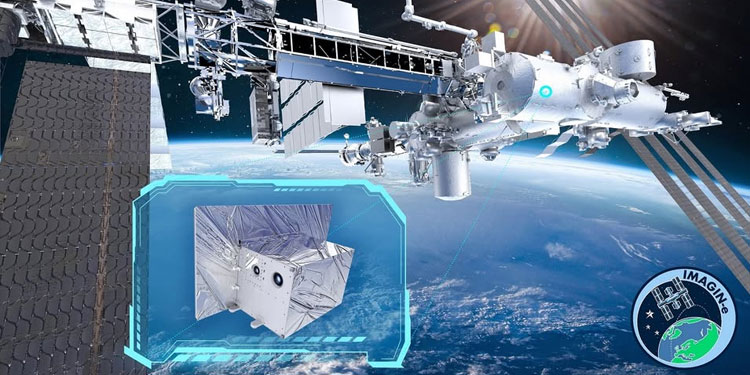
Blockchain technology has officially extended its reach beyond Earth’s atmosphere, thanks to a pioneering European initiative spearheaded by Thales Alenia Space and the Slovak tech firm 3IPK. The experiment, known as IMAGIN-e, made its way to the International Space Station (ISS) aboard SpaceX’s CRS-30 mission. Once installed in the European Columbus module, the device began functioning as an edge node, enabling real-time validation of scientific and environmental data generated in orbit.
This project, supported by the European Space Agency (ESA), introduces a novel approach to securing data transmissions between space and Earth. The system goes beyond conventional transmission by digitally signing, verifying, and storing data on a distributed blockchain network. The unique aspect of this initiative lies not only in the use of blockchain as a storage mechanism but also in the application of decentralised infrastructure directly within a space environment—an unprecedented move.
Ensuring Data Integrity in a New Frontier
With increasing reliance on satellite data for strategic, environmental, and industrial decision-making, the risk of tampering or unauthorized modification has grown. According to stakeholders involved in the initiative, the immutability provided by blockchain offers a robust defense. Each dataset, once created, is cryptographically sealed, and any changes to it are transparently recorded. This level of traceability ensures that the information collected in orbit remains credible, which is crucial when such data is used in climate research, disaster response, or economic planning.
The path to this launch began years earlier. By autumn 2023, ESA had already engaged Thales and 3IPK to develop a system for tracking satellite-derived data. Initial validation was carried out using data streams from the Copernicus Sentinel-2 satellite. The successful deployment of the IMAGIN-e unit aboard the ISS now marks the operational stage of the project, allowing the blockchain-based certification system to be evaluated in real space conditions. This real-world integration could be instrumental in advancing its adoption across future European space missions.
Collaborative Innovation Across Borders
The IMAGIN-e programme stands as a model of cross-sector cooperation, blending public funding with private innovation. Thales Alenia Space was responsible for building the hardware and adapting it for ISS compatibility. Meanwhile, 3IPK developed the core software architecture and tracking algorithms required for the blockchain platform. ESA, apart from financing the venture, positioned the project within its FutureEO innovation framework to promote sustainability and transparency in Earth observation initiatives.
IMAGIN-e Space Edge Computing demonstration payload reached the International Space Station to gather unmatched Earth observation insights https://t.co/Wq0iRNHIVh@msPartner pic.twitter.com/5SuBwiLvNq
— Thales Alenia Space (@Thales_Alenia_S) March 27, 2024
The potential applications for this space-grade blockchain solution are wide-ranging. If the ongoing test phase succeeds, the technology could be deployed to monitor environmental changes, verify emissions data, and certify datasets for sectors like finance and insurance. It could also play a role in maintaining traceability of mission-critical components, enhancing safety audits and maintenance schedules. In sensitive areas such as defense and institutional operations, the encrypted and tamper-resistant system could provide additional layers of protection for classified data.
Towards a Transparent and Interoperable Space Ecosystem
Unlike some other national space strategies, Europe appears to be placing emphasis on the credibility and compatibility of data sources. The IMAGIN-e mission underscores how a synergy between cutting-edge technology and open governance can serve collective objectives. Transparency, in this context, is positioned not as a bonus feature but as a core structural principle.
As satellite data becomes increasingly central to global decision-making, the integration of blockchain in space-based systems might well set a new standard for data integrity in scientific and geopolitical arenas. Through initiatives like IMAGIN-e, Europe is not just sending hardware into orbit—it is launching a new era of secure, transparent, and accountable space operations.