

Crypto market crash continues as Bitcoin loses 12% within a week, and the overall market cap reduces to 2.29 trillion, the lowest since July 2025. The significant price decline in the crypto market is uncalled for and has caused a 7% loss to overall market capitalization within a week. Bitcoin was trading at $113,700 on October 29, and within just 7 days, the price touched the $100,000 level. The same is happening to altcoins. Ethereum is down around 20% just like other major altcoins, including XRP, BNB, SOL, and ADA. However, the meme coins have suffered the most during this market bleed. Pengu is over 32% down while Pepe and Dogecoin have lost around 20% of their value within a week.
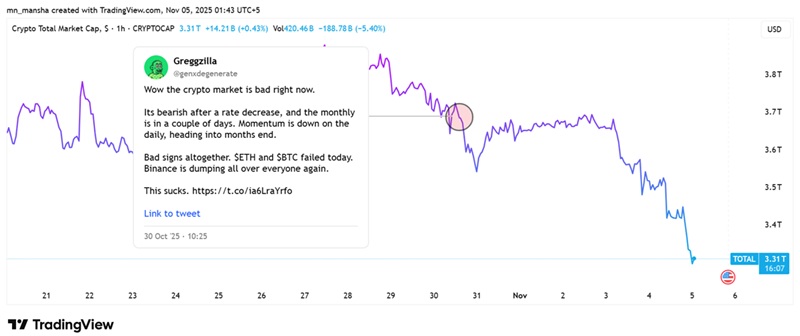
During the last two weeks, almost all the indicators have been positive, making this crypto collapse one of the most expected downturns. Everything is going smoothly on the surface. The Federal Reserve’s 25-basis-point rate cut injects liquidity and typically lifts risk assets, while an early US-China trade breakthrough eases geopolitical tension and renews confidence in global markets. Optimism also grows after Donald Trump’s re-election, reinforcing expectations of lighter regulation and institutional adoption.
Solana’s new ETF showed record inflows, Dogecoin rallied with X Payments integration, and public companies continued accumulating Bitcoin as Visa expands stablecoin support. Each of these developments showed market expansion rather than contraction.
Yet, despite the convergence of these bullish forces, the market took an abrupt and violent turn. Prices fell across major assets, wiping out leveraged positions in a near-total liquidation wave. The red candles consumed by the traders are considered to be the insiders with a 100% win rate. According to Coinglass liquidation data, during the last 24 hours, over $2 billion worth of positions have been liquidated.
Crypto Market Crash: Reason
On the surface, the technical and fundamental indicators were pointing to a bullish price action. However, there was a series of events pointing out otherwise. The first and most visible cause was profit-taking by long-term Bitcoin holders. Addresses inactive for nearly a decade moved more than 400,000 BTC to exchanges, locking in massive gains after the October highs. This triggered fear and opened the door for short-term traders to follow.
At the same time, liquidity across markets started to tighten. The Federal Reserve’s tone shifted again toward caution, and short-term rates such as SOFR jumped to their highest level in a year.
In short, whales sold at the top, liquidity dried up, and leverage did the rest. It was not a crash out of nowhere but a correction expected as a result of excess confidence and borrowed risk.
Bitcoin Liquidity Hunt
The recent drop appears to be a classic liquidity hunt rather than the start of a full reversal. The chart below shows how Bitcoin is expected to sweep through dense liquidity pockets below $100,000, reaching toward the Point of Control (POC) around $97,441.

The price is currently showing the signs of reversals on lower timeframes, but the trend still remains bearish. Therefore, the price may eventually try and sweep the collected liquidity at $88,000 if we don’t see a pullback from POC.
The current downtrend has drawn a wave of short positions, with a dense cluster of liquidations now building around the $112,000 level. Once the downward liquidity sweep finishes and the market clears out late longs, Bitcoin is expected to move upward to target these short positions.