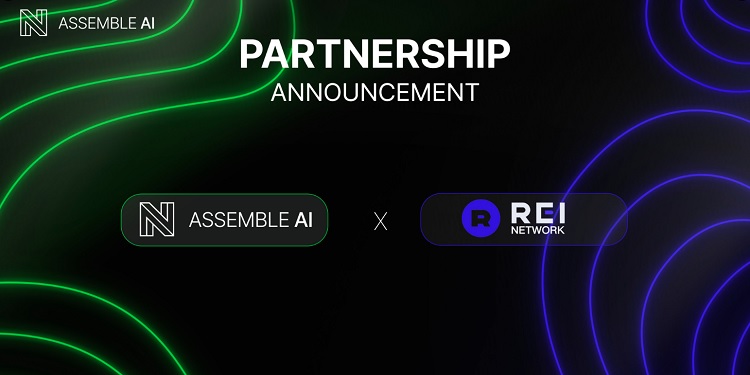
Assemble AI, an AI-powered crypto analytics platform, has announced a strategic partnership with REI Network, a public Layer 1 blockchain, in a move that aims to fuse artificial intelligence with blockchain infrastructure. The collaboration focuses on creating a unified ecosystem where AI-driven data processing meets REI Network’s high-speed, eco-efficient blockchain technology. Through this initiative, both entities seek to enable faster transactions, smarter analytics, and more intuitive blockchain experiences.
According to Assemble AI’s announcement on social media, the collaboration is designed to showcase how next-generation AI technologies can redefine blockchain interactions. The companies intend to establish a framework where artificial intelligence enhances blockchain operations, creating an environment that adapts in real time to data insights.
Bridging AI and Blockchain for Smarter Networks
The partnership between Assemble AI and REI Network is positioned to combine the decentralized power of blockchain with the decision-making intelligence of AI. The integration seeks to streamline processes, optimize network performance, and foster innovation within decentralized ecosystems. By aligning AI-driven analytics with blockchain’s transparency and security, the initiative is expected to deliver a new level of efficiency across digital asset ecosystems.
The two organizations aim to bridge a longstanding gap between blockchain scalability and automated intelligence. This alliance aspires to create a system capable of generating real-time insights while ensuring rapid, secure, and sustainable operations. Such advancements are expected to accelerate blockchain adoption, particularly among developers and enterprises seeking intelligent, data-backed transaction systems.
In addition, the collaboration is designed to empower developers to build smarter decentralized applications (dApps) that leverage real-time analytics and AI-based optimization. Enhanced on-chain analytics and faster transaction speeds could lead to improved operational benchmarks across blockchain platforms, setting new standards for performance and usability.
Empowering Developers and Users Alike
Assemble AI emphasized that the partnership with REI Network reflects a shared commitment to integrating AI-led decision-making within on-chain ecosystems. The companies view this as a step toward redefining how blockchain networks operate, helping developers, creators, and users access more powerful, responsive, and intelligent blockchain tools.
For developers, the partnership is expected to unlock a new generation of applications capable of self-optimizing based on real-time data inputs. For users, it could translate into faster, more reliable, and more interactive blockchain experiences that benefit from AI-enhanced adaptability. The initiative also demonstrates how blockchain and AI can converge to produce solutions that are both sustainable and technologically advanced.
Industry observers consider this collaboration a significant milestone in aligning AI with decentralized finance and Web3 innovation. By integrating Assemble AI’s analytical capabilities with REI Network’s eco-efficient consensus mechanism, the partners aim to create a more intelligent infrastructure that enhances network performance while maintaining energy efficiency.
Redefining the Future of Onchain Intelligence
The Assemble AI–REI Network alliance is expected to influence how blockchain ecosystems evolve in the coming years. By combining AI-based automation with blockchain’s decentralized structure, the collaboration sets a precedent for future projects aiming to deliver high-speed, insight-driven applications.
Ultimately, the partnership demonstrates a broader industry shift toward intelligent blockchain environments that are capable of adapting, learning, and responding to user needs in real time. Both Assemble AI and REI Network view this effort as a transformative step in shaping the next generation of blockchain solutions—where artificial intelligence enhances the core principles of decentralization, transparency, and scalability.