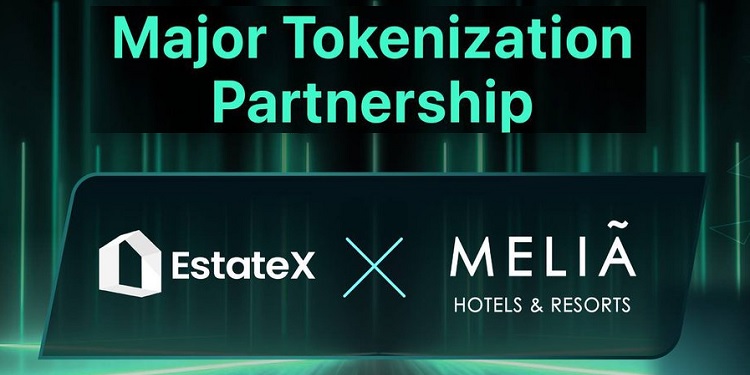
EstateX, a property tokenization platform enabling investments in real estate for as little as $100, has entered a strategic partnership with Melia Branded Resorts in Cape Verde. Through this agreement, a luxury beachfront resort will be tokenized and offered on-chain, marking EstateX’s second major property initiative following its highly successful U.S. launch. The earlier U.S. offering was reported to have sold out within minutes, supported by a recent $323 million FDV token launch in collaboration with DNA Fund, co-founded by blockchain entrepreneur and USDT co-creator Brock Pierce.
Opening Luxury Real Estate to Global Investors
Melia is an established hospitality brand with a presence of more than 300 hotels across 30 countries. The partnership with EstateX is seen as a move that opens the door for tokenization of high-value resort properties. By leveraging blockchain technology, smart contracts, and fractional ownership, the collaboration is expected to provide both retail and institutional investors with access to premium real estate opportunities that would otherwise remain limited to large-scale players.
Executives from both sides suggested that this initiative reflects a shared vision of innovation. EstateX’s leadership emphasized that Melia’s global reach and focus on forward-looking strategies align with the platform’s mission of creating a more inclusive property investment environment. Company representatives further stated that tokenized ownership could transform traditional property models by combining liquidity, transparency, and accessibility for a broader pool of investors.
Blueprint for Accessible Real Estate
EstateX’s management described the partnership as a step toward executing its broader plan of making luxury real estate widely accessible through blockchain. With the appointment of Steve Craggs, former CEO of RE/MAX England & Wales, as Web2 CEO of EstateX, the company has underlined its commitment to bridging traditional property markets with Web3 innovation. Craggs indicated that speed, liquidity, and transparency would form the cornerstone of these tokenized offerings, appealing directly to expectations of the growing Web3 investor community.
On the hospitality side, executives from Melia Cape Verde indicated that the collaboration brings unique ownership opportunities to participants. They explained that tokenized shares of prime beachfront hotel properties represent an innovative approach to both investment and hospitality management.
Blending AI, Blockchain, and Real Estate
EstateX has differentiated itself by integrating industry partnerships, artificial intelligence, and a dedicated blockchain infrastructure. The platform has outlined its roadmap with a strong emphasis on scaling global property listings and launching a real-world asset (RWA) native Layer 1 blockchain. In addition, AI adoption is planned to support the entire lifecycle of real estate investment, from property selection to portfolio management.
This approach, combining cutting-edge technology with established hospitality partnerships, is aimed at redefining how real estate assets are accessed and traded. By enabling fractional ownership and ensuring verifiable, transparent transactions, EstateX positions itself at the intersection of blockchain innovation and traditional property markets.
A Model for Future Property Investment
Observers believe that the EstateX-Melia collaboration signals a significant step toward mainstreaming tokenized property investment. By leveraging blockchain to open up access to high-value real estate, the partnership demonstrates how Web3 solutions can merge with traditional sectors to create sustainable, investor-friendly models.
EstateX’s trajectory, supported by its recent milestones and forward-looking roadmap, reflects a broader trend where real-world assets are increasingly being brought on-chain. For both seasoned investors and newcomers, the Cape Verde initiative may represent not only an opportunity for fractional participation in luxury properties but also a glimpse into how the property investment landscape could evolve in the years ahead.