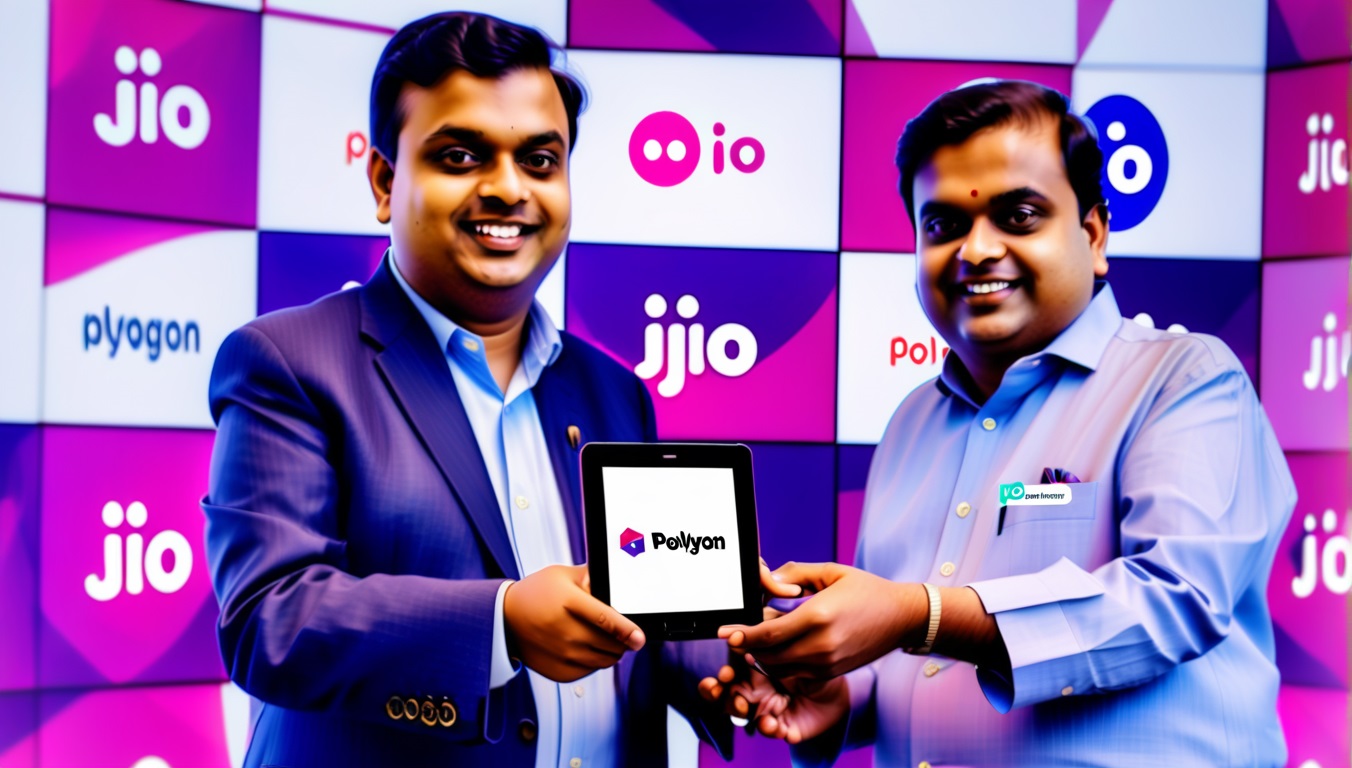
Polygon is taking a major step toward broadening Web3 accessibility in India through its collaboration with Reliance Jio, one of the country’s leading telecom providers. The partnership is aimed at integrating blockchain into existing digital services, potentially granting access to decentralized technologies to over 450 million users. This initiative is part of Polygon’s larger mission to accelerate the mainstream adoption of blockchain without compromising the core principles of the technology.
With Reliance Jio under the leadership of Mukesh Ambani, India’s wealthiest individual, the telecom giant is working with Polygon to incorporate blockchain-based features into JioSphere, its web browser. According to both parties, conventional methods would have made such integration costly and time-intensive. Instead, the alliance is intended to provide a smoother and more economical transition into decentralized platforms.
Polygon’s leadership has emphasized the need to balance speed, affordability, and decentralization. While the company has been rapidly scaling operations and forming alliances with major industry players, its core team has remained committed to safeguarding the foundational values of blockchain. They have maintained that achieving both scalability and decentralization simultaneously is not only feasible but also essential to their approach.
As part of its expansion efforts, Polygon is investing heavily in zero-knowledge (ZK) technologies. These solutions are designed to optimize performance across the blockchain ecosystem by enabling faster and more affordable transactions while preserving transparency and trust. The company believes that this dual focus on efficiency and security will offer a seamless experience for both developers and end users.
Polygon’s infrastructure already supports several active Web3 use cases, including stablecoin payments on its Proof-of-Stake network and real-world asset tokenization for institutional clients. The firm considers its combination of low transaction costs, high speed, and decentralized architecture as critical to its adoption strategy.
A key challenge identified by the team is to ensure blockchain technology becomes as user-friendly and intuitive as Web2 applications while retaining its decentralized essence. Polygon is banking on ZK technology and its Agglayer system to accomplish this, aiming for a trustless and interoperable environment that doesn’t sacrifice usability.
When it comes to onboarding Jio’s extensive and diverse user base, Polygon is taking a tailored approach. The company plans to collaborate closely with Jio to craft blockchain use cases that align with the specific needs and preferences of Indian consumers. The onboarding process will be gradual, guided by practical applications that provide real-world value.
The broader vision expressed by the Polygon team involves moving beyond technical use and engaging with societal challenges. One area where blockchain is seen as particularly promising is in combating misinformation, especially in an era dominated by AI-generated content like deepfakes. The company expects that increasing demands for trustworthy information will elevate the role of blockchain in content verification.
Polygon also sees growing potential in decentralized prediction markets such as Polymarket. These platforms are emerging as powerful tools for financial forecasting, risk analysis, journalism, and governance. By aggregating insights from various sources, they often offer a more reliable alternative to conventional opinion polls.
Ultimately, Polygon is positioning itself not just as a technology provider, but as a facilitator of a decentralized digital future. The leadership sees immense opportunity in solving real-world problems for large populations, and they believe that blockchain’s immutable nature can help reshape key sectors such as journalism, public policy, and economics. Through its partnership with Jio, Polygon aims to bring this transformative vision to one of the world’s largest and most dynamic markets.