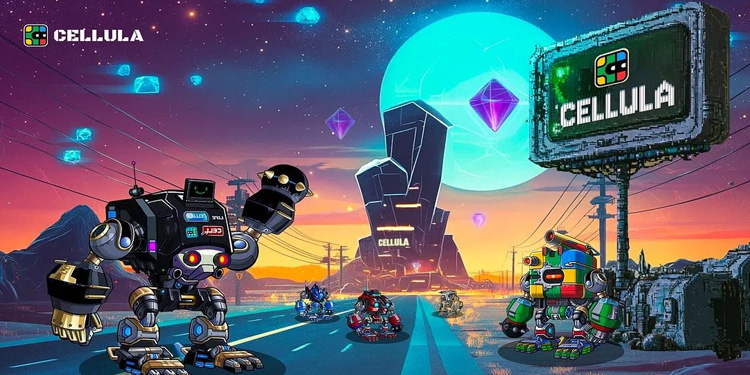
Cellula, a decentralized gaming platform, announced a strategic partnership with the ENI Chain aimed at redefining how blockchain miners and players are rewarded. The collaboration was presented as an effort to introduce a new incentive structure for participants on the ENI blockchain, potentially reshaping user interaction models within blockchain-based games. By aligning with ENI Chain, Cellula seeks to merge decentralized infrastructure with interactive entertainment in a way that goes beyond conventional reward mechanisms.
As part of the partnership, Cellula is integrating ENI Chain’s blockchain framework to bring Proof-of-Work-inspired mechanics into its gaming environment. The initiative was described as an attempt to incorporate the underlying principles and operational logic of Proof of Work into gameplay. This approach blends traditional mining concepts with interactive gaming elements, such as BitLife-style mechanics and on-chain mining activities, to form a hybrid incentive system that rewards both computational contribution and in-game participation.
Reflecting Broader Trends in Web3 Gaming
The move aligns with a wider shift across the Web3 gaming sector, where projects are increasingly seeking advanced blockchain infrastructures to enhance engagement and utility. Industry observers have noted that gaming platforms are gradually moving away from basic token-centric reward models. Instead, developers are experimenting with more immersive systems that link everyday activities or in-game actions with meaningful on-chain rewards.
Cellula’s strategy reflects this transition, as the platform aims to deepen player involvement by introducing mechanisms that feel more purposeful and interactive. By embedding mining-like activities directly into gameplay, the project intends to create a more engaging loop where users are rewarded for both strategic play and their contribution to network operations.
ENI Chain’s High-Performance Infrastructure
ENI Chain brings substantial technical capabilities to the partnership, having been designed to support large-scale commercial applications. The network reportedly supports transaction speeds of up to 10,000 transactions per second, combined with advanced parallel computing features. These capabilities enable ENI Chain to maintain high throughput even during periods of heavy demand, which is critical for transaction-intensive gaming environments.
The blockchain’s infrastructure is built on a triple-layer EPoS consensus model that integrates verifiable random functions, an enhanced Byzantine Fault Tolerance mechanism, and an additional performance-focused consensus layer. This layered approach is intended to balance performance, security, and reliability, making the network suitable for complex decentralized applications.
Cellula is thrilled to announce our partnership with @ENI__Official Together, we will build on ENI chain, bringing the spirit and mechanism of vPoW to this innovative blockchain. 🚀Get ready to get BitLife and mining on ENI , experiencing a brand-new incentive mechanism!
About… pic.twitter.com/hlDau5dlUY
— Cellula (@cellulalifegame) January 9, 2026
Modular Architecture and Developer Flexibility
A key aspect of ENI Chain’s appeal lies in its modular blockchain architecture. Through modular design principles and an AppChain framework, developers are able to build flexible Web3 applications without the constraints typically associated with monolithic blockchains. This design philosophy is increasingly viewed as essential for achieving scalability and adaptability in blockchain ecosystems.
For Cellula, these features translate into tangible benefits, including the ability to handle high volumes of player activity, manage intricate in-game economies, and deliver fast, responsive gameplay. High transaction throughput is particularly important for ensuring smooth user experiences in games that rely heavily on frequent on-chain interactions.
Shaping the Future of Blockchain Gaming
The partnership highlights a broader evolution in how blockchain gaming projects select their underlying infrastructure. Rather than relying on general-purpose networks or isolated project chains, developers are gravitating toward specialized solutions tailored to their specific requirements. The introduction of Proof-of-Work-inspired mechanics within a gaming context may establish a new engagement model, where players are rewarded not only for in-game achievements but also for their computational contributions.
Overall, the collaboration underscores the maturation of the blockchain gaming industry. As the sector moves beyond early hype cycles, greater emphasis is being placed on sustainable ecosystems, strong technical foundations, and long-term scalability. Cellula’s focus on modular architecture and infrastructure adaptability suggests a forward-looking approach aimed at supporting future growth and evolving gameplay experiences.