COCA, a self-custodial banking application available across more than 75 countries, has integrated Aurora Intents to simplify stablecoin deposits across multiple blockchain networks. The integration, built by Aurora Labs and powered by NEAR Intents, allows users to deposit supported stablecoins from numerous networks into a single reusable COCA address without manually selecting the destination blockchain.
The development is aimed at reducing one of the more complicated aspects of using digital assets: moving funds between blockchain networks before they can be spent. Users can now deposit supported USDC and USDT from more than a dozen networks, while also buying or selling COCA tokens directly within the application without using an external cryptocurrency exchange.
The Aurora Intents integration enables COCA users to deposit stablecoins from multiple blockchain networks through a simplified funding process, removing the need for manual network selection and cross-chain transfers.
In-app COCA trading removes external exchange requirement
The integration also changes how users can obtain COCA tokens through the platform’s Loyalty Program. Previously, users who wanted to acquire COCA tokens had to create an account with an outside exchange, purchase the tokens, and manually transfer them to their COCA application.
The new system brings that process into the COCA app. Users can purchase COCA tokens directly using their existing USD balance, while users holding the token in an external wallet can send it directly to the application.
The change is intended to reduce the number of steps involved in obtaining and using the token. It also removes the need for users to maintain an account on a separate exchange solely to acquire COCA.
Stablecoin support expands across major networks
COCA’s expanded deposit infrastructure supports USDC across NEAR, Ethereum, Arbitrum, Base, Solana, Gnosis, Polygon, Optimism, Avalanche, Sui, Stellar, Monad and X Layer.
USDT deposits are supported through NEAR, Ethereum, Tron, Solana, Gnosis, Polygon, Optimism, Avalanche, TON and Scroll.
Aurora Intents handles the cross-chain execution and settlement process in the background. This means users do not have to determine which blockchain their stablecoins are currently held on or manage separate bridge interfaces and network-specific transactions.
The approach reflects the growing use of chain abstraction in consumer-facing financial applications. Chain abstraction allows users to interact with digital assets without having to understand the underlying blockchain infrastructure. For consumers, the model can reduce the risk of sending funds through an incompatible network, an error that can potentially result in permanent asset loss.
COCA targets banking-like crypto experience
COCA combines self-custody with conventional financial services, allowing users to retain control of their funds while accessing features designed for everyday spending and saving.
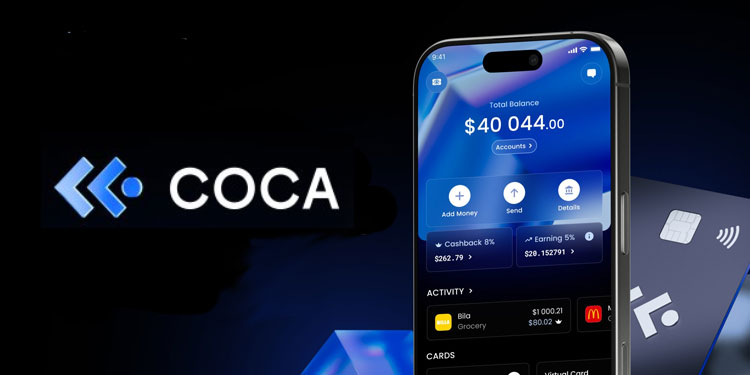
The application offers a Visa card that can be used for stablecoin and fiat purchases wherever Visa is accepted. It also provides a EUR IBAN, transfers, real-time annual percentage yield on eligible USD, USDC and USDT balances, cashback and subscription-related rewards.
According to COCA CEO Vasili Paulau, the integration addresses a usability issue because most consumers are primarily concerned with accessing and spending their money rather than understanding which blockchain holds their assets. He indicated that reducing technical decisions during funding could help build greater user confidence.
Does Aurora Intents support real-time cross-chain payments on @coca_card?
Declan breaks down what actually happens between depositing crypto and the card being ready to spend. pic.twitter.com/hBbaUreToj
— Aurora (@auroraisnear) August 17, 2026
Aurora CEO Declan Hannon similarly characterized the challenge as primarily a user-experience problem rather than a limitation of blockchain technology. He said COCA demonstrated how cross-chain infrastructure could operate in the background while presenting consumers with an experience closer to traditional banking.
By hiding cross-chain routing and network-specific complexity, the integration is designed to make stablecoin funding more accessible while reducing potential errors for consumers.
Self-custody remains central to platform
The integration builds on COCA’s existing card and banking infrastructure and its broader effort to combine cryptocurrency ownership with familiar financial services.
The company said its platform is designed to allow users to spend stablecoins and fiat through its card while retaining self-custody of their assets. The platform also includes stablecoin cashback of up to 8% and real-time yield features on eligible card balances.
The expansion marks another step toward chain-agnostic consumer finance, where users can interact with stablecoins across multiple networks without needing to understand the underlying blockchain infrastructure.
The partnership with Aurora Intents could therefore help COCA reduce technical barriers around deposits and token transactions while expanding the practical use of stablecoins for everyday financial activity.